Instant Quote
By Arborists NSW | Family-Owned | 22+ Years Servicing Greater Sydney
There’s always that one tree. You know the one. It’s been leaning a little further towards the house every winter. The roots are doing something suspicious near the back fence. Or maybe a wild storm last season snapped half its canopy and it’s been looking rough ever since. Whatever the situation, you’ve finally decided it’s time to sort it — but then you hit the wall of questions: Do I need a council permit? How much is this going to cost? Can I just chop it down myself on a Saturday morning? (Short answer: please don’t.)
This guide covers everything a Sydney homeowner needs to know about tree removal in 2026 — from council rules and permit processes to honest cost breakdowns, what the job actually involves, and how to get it done safely without receiving a fine that’ll ruin your week.
First Things First: Do You Actually Need Council Approval?
This is the question that trips up almost every property owner, and the answer in Sydney is almost always: yes, very likely.
Sydney’s trees are protected under the State Environmental Planning Policy (Vegetation SEPP) as well as individual council Development Control Plans. This means that even on your own private property, removing a tree without the right approval can land you with a fine ranging from $1,100 all the way to $1.1 million for serious breaches. That’s not a typo.
Most Sydney councils require a permit for trees over roughly 4–5 metres in height or with a trunk diameter exceeding 30–40cm at chest height. But here’s where it gets complicated — the exact threshold varies depending on which council area your property sits within.
Councils in the North Shore area including North Sydney, Lane Cove, and Ku-ring-gai place a strong emphasis on maintaining tree canopy cover and keep significant tree registers for notable specimens. If you’re in Wahroonga, Killara, Gordon, or Turramurra, the rules are particularly detailed — these are some of the most tree-dense suburbs in Greater Sydney and councils protect that canopy seriously. Our teams work across Wahroonga, Killara, Gordon, Turramurra, and Roseville daily and know the local permit requirements inside out.
There are exemptions — but don’t assume:
The City of Sydney exempts certain invasive or weed species from permit requirements, including African olive, false acacia, and cocos palm. Some councils also exempt trees that are confirmed dead or dying — but you still typically need a qualified arborist with a minimum AQF Level 3 certification to document that condition in writing before you touch it.
For genuinely hazardous trees posing immediate safety risks, emergency removal can proceed without prior approval, but retrospective applications may be needed and council should be notified as soon as practical. Keep photo evidence of the emergency conditions.
The bottom line: before you fire up any machinery, check with your local council or talk to a licensed arborist who knows your area. Getting this step wrong is expensive.
How to Remove a Tree in Sydney: The Step-by-Step Process
Tree removal looks simple from the street — someone shows up with a chainsaw, the tree comes down, done. The reality, especially for larger trees in Sydney’s dense residential suburbs, is considerably more involved. Here’s how a proper, professional job unfolds.
Step 1: On-Site Assessment
A qualified arborist inspects the tree in person. They’re looking at species, height, trunk diameter, root structure, proximity to structures and power lines, soil condition, and any signs of disease or structural weakness. This assessment determines the removal method, equipment required, and whether a council permit is needed.
All tree works in Sydney must be done by a qualified arborist with a minimum Level 3 in arboriculture (AQF) in compliance with the SafeWork NSW Code of Practice for the Amenity Tree Industry. If someone shows up without qualifications and wants to cut your tree down for cash, walk away. The liability risk alone isn’t worth it.
Step 2: Council Permit Application (Where Required)
If your tree requires council approval, your arborist prepares and lodges the application. This typically includes a written arborist report, supporting photos, and the relevant application fee. Most Sydney council tree removal applications take 2–4 weeks to process when properly submitted.
Application fees generally range from $98 to $300 depending on the council, with more complex heritage tree cases requiring a full Development Application. A good arborist will handle this paperwork — that’s part of what you’re paying for.
Step 3: Site Setup and Safety Measures
On the day of removal, the crew sets up safety exclusion zones, lays protective ground cover where needed, and positions equipment — chippers, elevated work platforms, or cranes for complex jobs. Neighbours are usually given a heads-up. Traffic management may be required for trees near roadways.
Step 4: Crown Removal and Sectional Dismantling
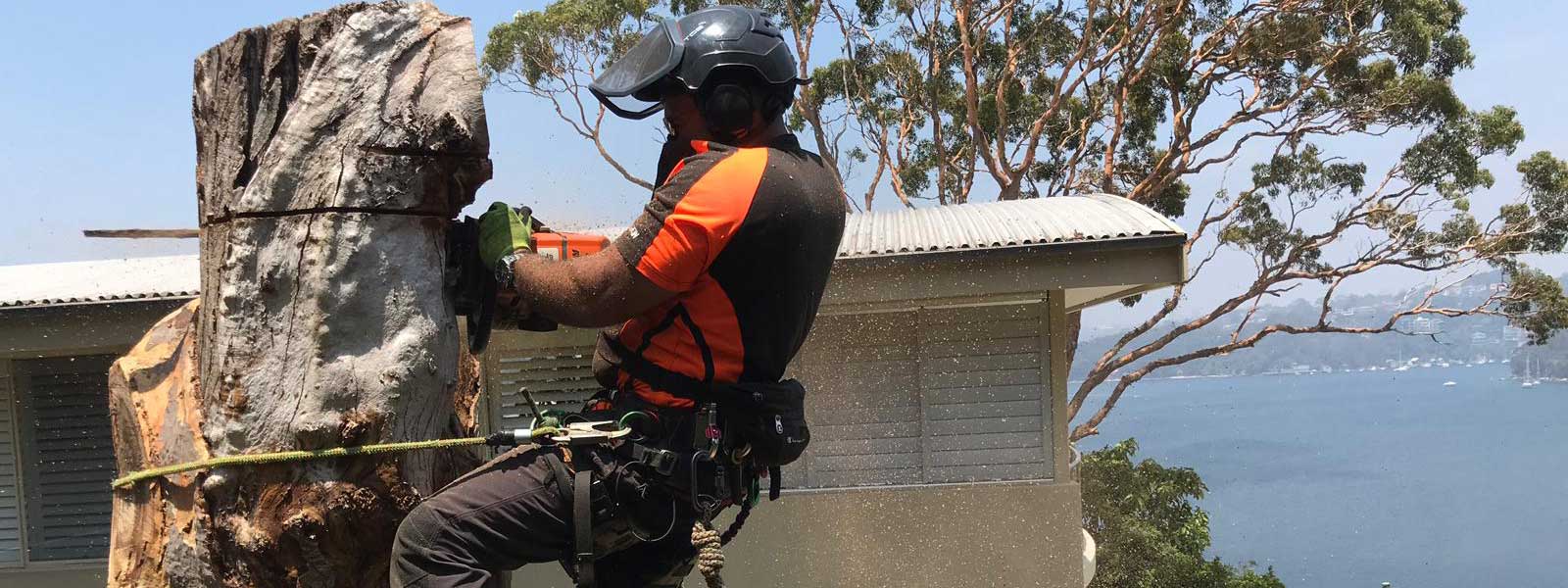
For most urban removals in Sydney, trees aren’t simply felled in one piece — there’s rarely the space. Instead, the canopy is removed in sections from the top down, with branches carefully lowered using ropes or rigging systems to avoid damage to fences, gardens, and structures below. This is the part that requires real skill.
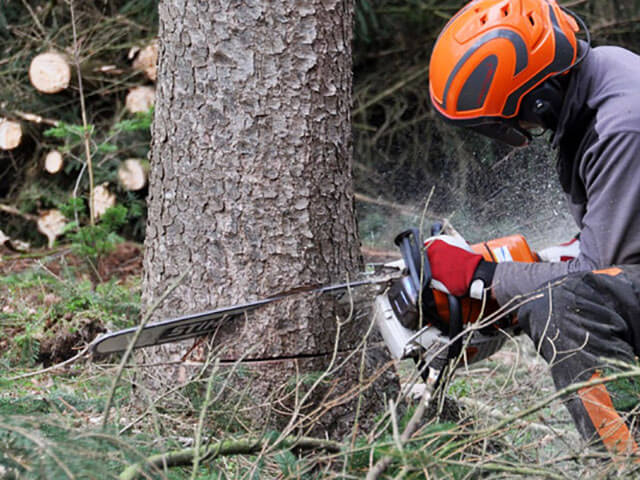
For large eucalypts in suburbs like Pennant Hills or Castle Hill where block sizes allow, controlled directional felling may be possible — it’s faster and cheaper. Your arborist will advise on the safest approach for your specific site.
Step 5: Trunk Removal
Once the crown is cleared, the trunk is cut in sections from the top down. For trees close to buildings or fences, each section is lowered under control. For clear-access properties, sections can be felled once the area is confirmed safe.
Step 6: Stump Grinding
The stump doesn’t disappear just because the tree is gone. Leaving it creates a termite habitat, allows regrowth from the root system (especially with figs and some gums), and is a trip hazard. Stump grinding uses a rotating cutting wheel to grind the stump down below ground level — typically 20–30cm — leaving a pile of wood chips that can be mixed back into the soil or removed.
Always confirm upfront whether stump grinding is included in your quote. It often isn’t, and adding it after the fact costs more than agreeing to it as part of the original job.
Step 7: Site Cleanup and Woodchipping
A professional crew leaves your property cleaner than they found it. All debris is fed through an industrial chipper, and the resulting mulch can be left on site for your garden beds (genuinely excellent for moisture retention and weed suppression), or taken away entirely. Tree mulching and woodchipping is an environmentally sound way to get value from the removed timber rather than sending it to landfill.
If you want to keep some logs as firewood — particularly from dense hardwoods like ironbark or spotted gum — let your arborist know beforehand. Most crews can leave sections cut to length.
Tree Removal Cost in Sydney: Honest 2026 Pricing
Let’s get into numbers — because this is what most people are actually googling.
Tree removal in Sydney costs $250–$5,500+ depending on tree size, location, access difficulty, and species. Small trees under 5m typically cost $250–$800, medium trees 5–10m cost $800–$2,500, and large trees over 10m cost $2,500–$5,500+.
Here’s how that plays out across different scenarios:
Small tree (under 5m) — typical backyard ornamental, young Liquid Amber: $300–$800
Medium tree (5–10m) — established Lilly Pilly, mid-size Grevillea, small Eucalypt: $800–$2,500
Large tree (10–15m) — mature gum tree, Camphor Laurel, large Jacaranda: $2,500–$5,500
Extra-large or complex removal (15m+, near structures, crane required): $5,500–$15,000+
Sydney tree removal costs average around $2,354, approximately 35% above the national average, reflecting factors like urban density, challenging property access, proximity to power lines, and high demand for qualified professionals.
What pushes the price up?
- Power line proximity — working near energised lines requires specialised safety procedures and sometimes a separate contractor for line clearance. Add $500–$2,000.
- Difficult access — narrow side gates, pools in the way, sloped blocks, or neighbouring properties that don’t allow access all affect how long the job takes.
- Stump grinding — add $300–$800 per stump depending on diameter.
- Council permit costs add $65–$250 for most residential applications, with heritage or development applications costing significantly more.
- Emergency or after-hours callouts — urgent storm-damage tree removal can cost 30–50% more due to priority scheduling and higher safety risk.
How to get the best value:
Get three written, itemised quotes from licensed arborists. “Itemised” is the key word — a quote that just says “tree removal — $900” doesn’t tell you whether debris removal, stump grinding, or permit assistance is included. Combining multiple trees in a single booking saves on equipment mobilisation costs — the crew and chipper are already on site.
Suburbs like Epping, Eastwood, Carlingford, and Marsfield tend to have established gardens with multiple trees — if you’ve got more than one tree to remove or prune, group the work and ask for a combined quote.
Tree Pruning vs. Tree Removal: Which Do You Actually Need?
Not every problem tree needs to come down completely. Before committing to removal, it’s worth getting an honest assessment of whether professional pruning and trimming could solve the actual problem at a fraction of the cost.
Tree pruning makes sense when:
- The tree is structurally sound but has branches overhanging your roof, gutters, or neighbour’s fence
- It’s a heritage or council-protected specimen that can’t be removed anyway
- The tree has significant visual or ecological value and selective crown reduction would address the safety concern
- You want to improve light, air circulation, or shape for a feature tree
Tree removal is the right call when:
- The tree is dead, diseased through the core, or structurally compromised beyond recovery
- Roots are actively damaging foundations, drainage, or underground services
- The tree is an invasive species (like African olive or cocos palm) that will regrow aggressively from any stump
- Risk to structures or people cannot be adequately managed through pruning
A good arborist will tell you honestly which one you need — even if removal means a bigger job and more money for them. At Arborists NSW, we provide written quotations for both options where applicable, so you can make an informed decision.
Emergency Tree Services: When You Can’t Wait
Sydney storms don’t send warning letters. One hour your gum tree is fine; the next it’s dropped a branch through your carport roof or is leaning at a very uncomfortable angle over the back fence after a southerly. That’s an emergency.
Hazardous trees posing immediate safety risks can be removed without prior council approval when they threaten property or personal safety due to storm damage, disease, or structural instability — but a qualified arborist with minimum Level 3 certification must assess and document the tree’s condition.
Our 24/7 emergency tree services cover storm response, fallen branches, trees leaning toward structures, and any situation where a tree poses an immediate safety risk. We respond fast, sort the immediate hazard, and handle any retrospective council notification requirements.
Keep our number saved before you need it: 0439 413 375. Storm season doesn’t wait for business hours.
Beyond Tree Removal: Other Services Worth Knowing About
Tree removal is often just one part of what a property needs. Here’s what else we handle across Greater Sydney:
Land clearing and site preparation. Got a large block that needs clearing for development, landscaping, or a new structure? Land clearing involves removing trees, stumps, vegetation, and debris to a clean, level state. This is common in suburbs like Baulkham Hills, Castle Hill, and Pymble where larger blocks are being subdivided or developed. Permits are almost always required for clearing work of this scale, and our team manages the approval process end-to-end.
Stump grinding. That stump you left three years ago? Time to deal with it. Professional stump removal eliminates the regrowth risk, trip hazard, and termite invitation in a couple of hours.
Tree services across the Upper North Shore and Hills District. Whether you’re in Lane Cove, Lindfield, or Pymble, our crews service the full northern corridor of Greater Sydney. Smaller suburbs like Roseville and Gordon have dense established plantings that require experienced hands — which is exactly what our arborists bring.
Why Hire a Qualified Arborist — Not a Bloke With a Chainsaw
This isn’t snobbery. It’s about protecting you.
Sydney’s property and liability environment means that if an uninsured “tradie” drops a branch through your neighbour’s pergola, or removes a council-protected tree without permits, you as the property owner can be held liable. Not them — you.
A proper arborist carries:
- Personal and property damage insurance, plus workers’ compensation
- AQF Level 3+ arboriculture certification (the minimum legal requirement for tree work)
- Knowledge of council regulations across specific local government areas
- Professional equipment — proper rigging, chippers, elevated work platforms, and safety gear
At Arborists NSW, we’re a family-owned business that’s been operating in Sydney for over 22 years. We provide written quotations upfront, carry full insurance, and our entire crew takes an active role in every job. We can handle everything from a single backyard tree to large-scale land clearing — and if you want to keep the firewood logs or use the mulch, just say so.
A Quick Word on DIY Tree Removal
Is it possible to remove a small tree yourself? Sure, for a tiny ornamental under 3m with no nearby structures, power lines, or council restrictions. But here’s the honest assessment: most situations that seem simple aren’t. A leaning trunk behaves unpredictably when cut. Root systems extend further than you’d expect. And if you’re anywhere near power lines, the risk is genuinely life-threatening.
For anything over chest height, near structures, or within council-regulated size — please call a professional. The cost of a quote is zero. The cost of getting it wrong is not.
Ready to Get Your Tree Sorted?
Whether you’ve got a single problem tree in Epping or a full block in Castle Hill that needs clearing before construction, we’re ready to help. We service the full Greater Sydney metropolitan area, with specialist knowledge of council requirements across the North Shore, Hills District, and Inner West.
Call 0439 413 375 or visit arboristsnsw.au to request your free, no-obligation quote. We’ll do a proper on-site assessment, advise on any council requirements, and give you a written quote covering everything — no nasty surprises.
We live and breathe trees. We’ll take care of yours properly.
Arborists NSW is a family-owned tree services business based in Sydney, servicing domestic and commercial properties across the greater metro area for over 22 years. All works are fully insured and carried out by qualified arborists. Phone: 0439 413 375.
You might also find useful:
- Full tree removal and cutting services in Sydney
- Tree pruning and trimming across Sydney
- Emergency tree services — 24/7 response
- Stump grinding and stump removal
- Land clearing and site preparation